
 русский
 عربى
 Tiếng Việt

Professional coating line specially designed for large castings and heavy truck parts, applicable to various large castings (engineering castings, mining equipment castings, industrial castings) and h...
See Details
Yueze Environmental Protection provides one-stop compliant industrial surface treatment solutions with professional tech and fine craftsmanship.
 Get Inquiries
2026-10-22
Content
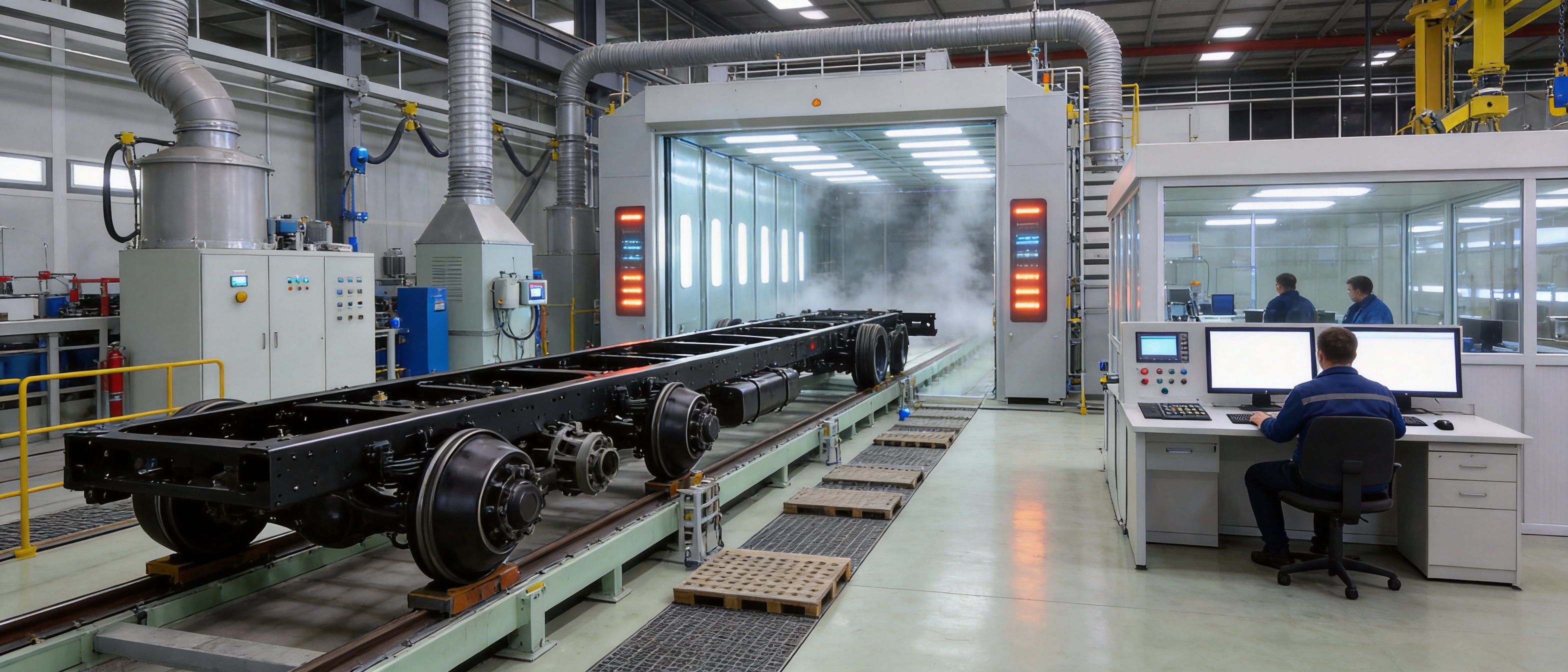
Large castings and heavy truck components require a coating system that is fundamentally different from a conventional passenger-car painting line. Engine blocks, axle housings, counterweight blocks, truck frames, wheel hubs, fenders, gearbox housings, mining equipment castings, and other industrial parts are heavier, larger, and more irregular than ordinary sheet-metal components. Their surfaces may contain casting sand, oxide scale, pores, oil, rust, sharp edges, recessed areas, and complex internal structures. A reliable coating line must therefore combine heavy-load conveying, thorough surface preparation, flexible spray coverage, controlled curing, environmental protection, and stable production management.
The coating line for large castings and heavy truck parts is designed around these demanding conditions. It can integrate grinding, finishing, degreasing, washing, derusting, phosphating, drying, primer application, topcoat application, curing, inspection, and unloading into one coordinated production system. Depending on the workpiece and coating material, the line can be configured as a full-automatic liquid painting line, an anti-corrosion line for heavy truck parts, an integrated pretreatment and spraying line, a large-workpiece electrostatic coating line, or a customized heavy-duty coating production line.
Compared with general-purpose coating equipment, this type of line offers stronger structural support, larger working dimensions, more adaptable spray arrangements, and a control system capable of managing different workpiece programs. It is suitable for manufacturers that need repeatable quality and higher throughput while reducing dependence on manual spraying. It also helps production facilities meet increasingly strict requirements for waste gas collection, paint mist filtration, energy efficiency, noise control, and workplace safety.
Jiangsu Yue Ze Environmental Protection Equipment Co., Ltd. develops and manufactures customized industrial coating equipment for large and medium-sized workpieces. Its product range includes powder coating lines, paint and bake booths, large-part grinding rooms, automated conveyor systems, infrared radiation drying systems, waste gas treatment equipment, intelligent coating lines, and related environmental protection equipment. Through integrated engineering, manufacturing, installation, and service, the company can design a complete line around the customer’s parts, coating process, plant layout, and production capacity.
Many coating problems begin before the spraying stage. A casting may retain molding sand, flash, scale, oil, or rust after removal from the foundry. A truck chassis may have long members, enclosed sections, brackets, and narrow corners that are difficult to reach with a fixed spray gun. An axle housing may combine broad external surfaces with deep recesses and internal cavities. If the line is not designed for these geometries, the coating may be uneven, thin at edges, excessive in corners, or absent in hidden areas.
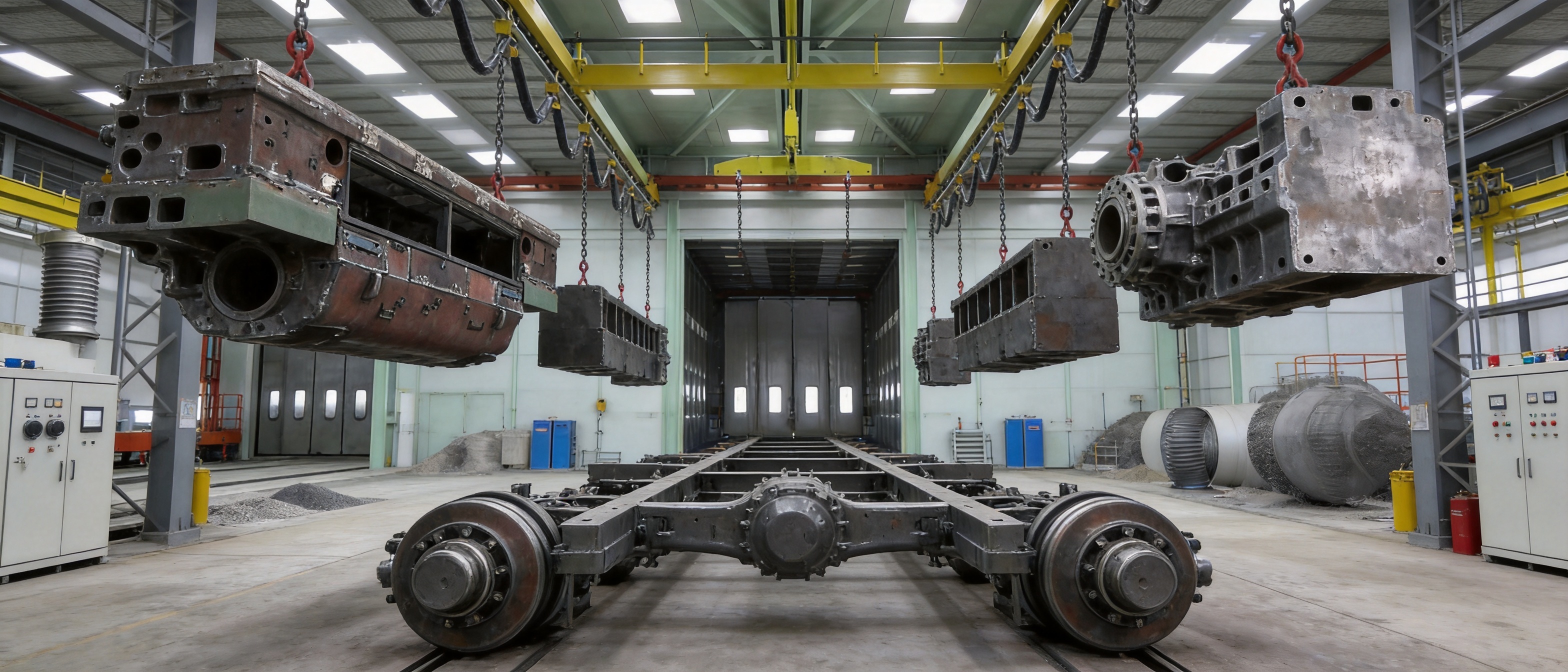
Weight is another decisive factor. Heavy castings can weigh from several tens to several hundreds of kilograms, while certain frames, counterweights, and industrial assemblies may be even heavier. A light-duty conveyor can deflect, vibrate, or suffer premature wear when it carries such loads continuously. A dedicated heavy-duty system uses reinforced rails, load-bearing trolleys, properly selected hooks, reliable drive units, and sufficient safety margins. The objective is to move every part smoothly without swinging, collision, or sudden changes in position.
Large workpieces also require additional booth width and height. The spray booth must provide sufficient clearance around the part so that operators or automatic guns can reach the required surfaces while maintaining safe airflow. The curing section must be long enough, or sufficiently powerful, to heat thick metal sections and coating layers evenly. A line designed only by nominal part length may fail when the part rotates, swings, or includes protruding brackets and attachments.
For these reasons, a professional coating line is engineered from actual production data rather than selected from a standard catalog. Maximum workpiece dimensions, maximum weight, hanging points, surface condition, coating type, target film thickness, takt time, annual output, and available factory space all influence the final design.
A typical line for large castings and heavy truck parts follows a continuous sequence, although the exact configuration depends on the material and coating specification.
Some projects use a dry mechanical preparation process instead of wet chemical pretreatment. This may include shot blasting, abrasive blasting, grinding, polishing, or a combination of methods. Other projects use a simplified process for parts that have already received corrosion protection upstream. The system can therefore be configured around the required coating specification rather than forcing every customer to use an identical process.
The line’s control architecture coordinates the conveyor, booth fans, spray equipment, pumps, heating units, filtration devices, drying zones, and safety interlocks. Operators can select a workpiece program and apply preset parameters such as conveyor speed, spray duration, curing temperature, fan operation, and process timing. This creates a more consistent working method than manually estimating each operation.
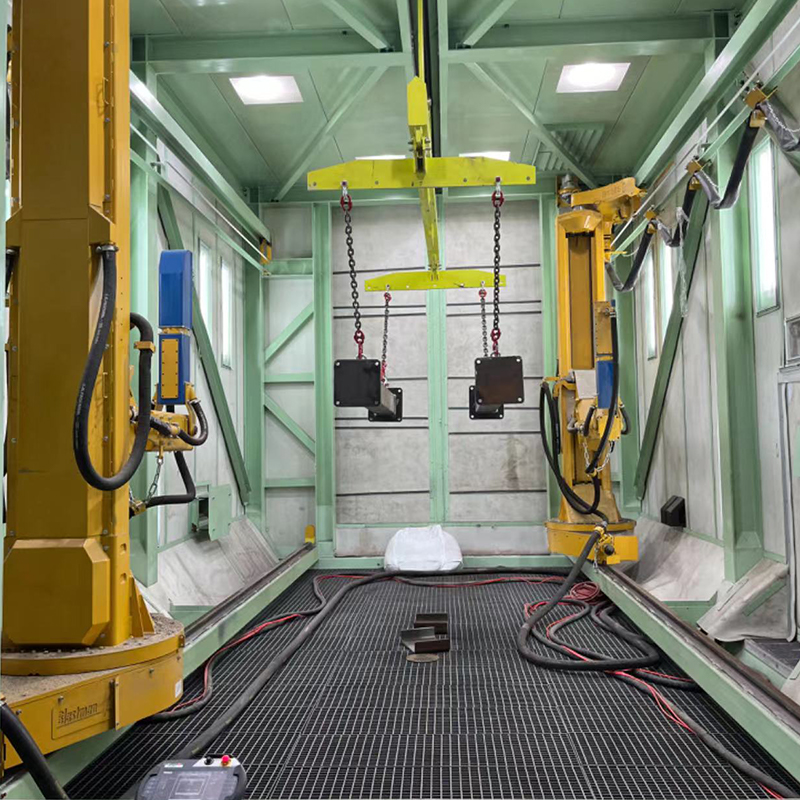
Coating Line for Large Castings & Heavy Truck Parts
The conveyor is the foundation of a large-part coating line. If the workpiece moves unevenly, every later operation becomes more difficult. Uncontrolled swinging can alter the distance between the spray gun and the surface, produce uneven film thickness, and increase the risk of collision with booth walls or neighboring parts. The conveying system must therefore be stable under load and synchronized with the coating process.
Depending on the factory layout, the line may use a hanging conveyor, powered monorail, floor conveyor, chain conveyor, roller system, or a combined conveying arrangement. Hanging systems are especially useful when the floor must remain available for production activities and when parts need to rotate or pass through multiple processing zones. Floor-based systems may be preferred for extremely heavy components or parts that are difficult to hang safely.
Heavy-duty hooks and fixtures are selected according to the part’s weight, center of gravity, shape, and required coating coverage. Custom fixtures can hold axle housings, frames, counterweight blocks, wheel hubs, or engine parts in a way that exposes important surfaces to the spray pattern. In some applications, rotating devices can turn a workpiece during spraying so that the coating reaches both sides, lower sections, recesses, and internal edges.
Compared with a light automotive conveyor, a heavy-load system offers several practical advantages. It can operate with a higher allowable load, resist deformation, reduce vibration, and maintain a predictable part position throughout the process. Reinforced components and accessible maintenance points also help extend equipment life and reduce unplanned downtime.
| Design Area | Dedicated Heavy-Part Coating Line | General-Purpose Equipment | Production Benefit |
|---|---|---|---|
| Conveyor capacity | Reinforced rails, trolleys, hooks, and drive units | Usually designed for lighter components | Supports heavy castings with less vibration and wear |
| Booth dimensions | Customized width, height, and length | Standard dimensions may restrict large parts | Improves clearance and spray accessibility |
| Surface preparation | Grinding, cleaning, derusting, phosphating, or blasting options | Often limited to basic cleaning | Creates a cleaner and more uniform coating base |
| Spray coverage | Adjustable guns, multiple angles, and workpiece rotation | May leave blind areas on complex parts | Reduces coating dead zones and rework |
| Curing capacity | Designed for thick metal sections and heavy coating layers | May heat unevenly or require excessive cycle time | Improves curing reliability and throughput |
| Control system | Programmable recipes for different workpieces | Limited manual adjustment | Supports repeatable batch production |
| Environmental equipment | Integrated filtration, exhaust, and waste gas treatment | May require separate or insufficient controls | Supports cleaner and more compliant operation |
Coating performance depends heavily on surface preparation. Even a high-quality paint or powder coating cannot compensate for oil, loose rust, sand, dust, or unstable oxide layers underneath the film. For large castings and truck parts, pretreatment must address both broad surfaces and difficult defects such as pores, sand holes, sharp edges, weld spatter, and recessed contamination.
The grinding and finishing stage removes flash, burrs, adhering sand, sharp projections, and other casting irregularities. It can include manual grinding stations, mechanical grinding rooms, polishing tools, dust collection equipment, and inspection areas. A well-designed grinding room protects adjacent production zones from abrasive dust and provides a safer, more organized environment for surface correction.
Where wet pretreatment is required, the process may begin with degreasing to remove machining oils and handling contamination. Water washing removes dissolved residues. Derusting or descaling then eliminates corrosion products and oxide layers. Phosphating or another conversion treatment can improve adhesion and provide additional corrosion resistance before primer application.
Drying is essential after wet treatment. Residual water in seams, cavities, and joints can cause blistering, poor adhesion, flash rust, or coating defects. Large components often retain moisture longer than thin panels, so the drying section must be sized for the actual geometry and thermal mass of the workpieces.
The pretreatment process can be adapted to the material and production requirements. Some castings need more mechanical preparation because of their rough surface texture. Some truck components require chemical cleaning and conversion treatment to meet an anti-corrosion specification. The line can combine different stages when the customer needs a more comprehensive process.
Large castings and heavy truck components typically require coverage on exterior surfaces, internal edges, corners, recesses, and structural gaps. The coating system must achieve the target film thickness without excessive overspray or sagging. A common configuration combines high-voltage electrostatic spraying with controlled atomization. Depending on the coating material, air spray, airless spray, electrostatic liquid coating, or powder coating equipment may be selected.
Electrostatic spraying can improve transfer efficiency by creating an electrical attraction between charged coating particles and the grounded workpiece. This is particularly useful for broad metal surfaces and can reduce material loss when parameters are correctly adjusted. However, electrostatic effects are less effective in deep recesses and shielded areas. For this reason, professional line design may combine different gun positions, manual touch-up stations, rotation mechanisms, and specialized spray angles.
Film thickness can be adjusted according to the corrosion protection and appearance requirements. A typical target range may be approximately 50 to 200 micrometers, although the final specification depends on the coating material, substrate, service environment, and customer standard. Automated parameters help maintain the required thickness across different batches.
The system can support primer, intermediate coat, topcoat, clear coat, or powder coating processes. Primer creates the foundation for adhesion and corrosion resistance. The topcoat provides color, appearance, chemical resistance, weather resistance, and impact protection. For heavy truck parts exposed to road dust, moisture, vibration, salt, and temperature changes, the coating system must be selected as a complete layered solution rather than as an isolated paint application.
Proper booth airflow is equally important. Air movement must carry overspray away from the workpiece without disturbing the spray pattern or causing excessive turbulence. The booth design, filtration arrangement, exhaust capacity, and spray parameters should be balanced to protect coating quality and maintain a safe working environment.
Curing is often more demanding for large castings than for thin automotive panels. Heavy metal sections absorb and distribute heat differently, and thick coating layers may require more time to reach their specified curing condition. If the coating is under-cured, it may have poor hardness, weak adhesion, insufficient chemical resistance, or reduced durability. If it is overheated, the coating may discolor, blister, crack, or lose its intended performance.
Convection curing furnaces heat the surrounding air and transfer heat to the workpiece. They are suitable for many coating processes and can be designed with insulated panels, circulation fans, burners, electric heaters, or other thermal systems. Infrared radiation drying provides another option. Infrared energy heats the coating and workpiece surface directly, helping accelerate flash-off and curing for selected primer and topcoat systems.
Infrared radiation is especially useful when the production line must handle heavy castings with thick coatings. It can reduce the time required to bring the coating to the desired condition and may help create a more compact curing section. The exact selection depends on the coating chemistry, part material, part thickness, surface color, line speed, and required temperature profile.
Energy-saving curing equipment can incorporate heat recovery, improved insulation, optimized airflow, and intelligent temperature management. According to the supplied product information, the integrated energy-saving approach can reduce energy consumption by approximately 30 percent in suitable applications. Actual savings depend on furnace size, production schedule, ambient conditions, fuel or electricity costs, and operating parameters.
Cooling zones may be installed after curing to bring workpieces to a safe handling temperature before inspection or unloading. Controlled cooling also helps protect operators and prevents premature packaging or contact damage.
A modern coating line must control paint mist, volatile organic compounds, dust, wastewater, noise, and heat. Environmental equipment is therefore not an optional accessory but a core part of the production system. Paint booths can use dry filters, water curtain systems, cartridge filtration, activated carbon, catalytic treatment, or other combinations selected according to the coating material and emission requirements.
Grinding rooms require effective dust collection to capture abrasive particles and casting residue. A suitable extraction system protects workers, improves visibility, reduces contamination of painted surfaces, and helps keep the factory cleaner. Filter maintenance access should be considered during the engineering stage so that replacement and cleaning can be performed without excessive downtime.
Paint mist generated during spraying should be captured before it reaches the exhaust duct or surrounding workplace. Proper filtration protects fans, ducts, treatment units, and the external environment. For solvent-based coatings, waste gas treatment may be added after filtration to reduce volatile emissions. The final environmental configuration must be confirmed according to local regulations, coating composition, production volume, and site conditions.
Noise control is also relevant in a heavy industrial plant. Fans, pumps, compressors, grinding tools, burners, and conveyor drives all contribute to the overall sound level. Equipment layout, acoustic insulation, vibration reduction, and appropriate operating practices can help maintain a more comfortable workplace. The supplied product information identifies a target noise level below 75 decibels for the described energy-saving and environmental approach, subject to actual project conditions and measurement methods.
Safety interlocks can stop spraying or heating when a door is opened, airflow falls below the safe level, an over-temperature condition occurs, or a conveyor fault is detected. Emergency stop devices, fire protection, grounding, overload protection, access platforms, and maintenance isolation procedures should be included in the complete design.
Automation improves more than production speed. It also improves repeatability. Manual coating operations can vary because of operator technique, fatigue, spray distance, gun angle, overlap, and timing. A programmable line can store process recipes for different workpieces and recall the corresponding parameters when a new batch begins.
The PLC control system can coordinate conveyor speed, spray equipment, pretreatment timing, furnace temperature, fan operation, pump pressure, and safety functions. A human-machine interface allows operators to monitor operating status, adjust approved parameters, review alarms, and manage production modes. Sensors can monitor temperature, pressure, airflow, position, and equipment status.
Automatic loading and unloading may be added when production volume is high. Identification systems can help associate each workpiece with a specific process recipe. Data recording can support quality analysis, maintenance planning, and traceability. These functions are especially valuable when a factory produces several part families on one flexible line.
Automation should be matched to the actual production requirement. A fully automatic system may be suitable for stable high-volume production with predictable part geometries. A semi-automatic line may be better when the product range changes frequently or when manual finishing is required for complex castings. The modular design allows the customer to begin with the necessary automation level and add equipment later as production grows.
Compared with a basic manual spray room, an automated line can improve coating efficiency by more than 40 percent in appropriate production conditions, according to the supplied product information. The actual improvement depends on the number of operators replaced, part loading time, conveyor cycle, pretreatment requirements, spray method, and production mix.
One of the main strengths of a customized line is its ability to handle more than one type of workpiece. However, flexibility must be engineered carefully. Counterweight blocks, truck axles, frames, engine components, and wheel hubs have different shapes, weights, and coating challenges.
Counterweight blocks are dense and compact. They require strong fixtures and a conveyor with a high load rating. Their broad surfaces may be easy to spray, but edges, bottom surfaces, and lifting points require deliberate fixture and gun planning.
Truck axles are long and may include housings, tubes, mounting points, and recessed sections. The booth must provide sufficient length and height, while spray guns may need multiple angles to cover the underside and end sections. Rotation or repositioning may be useful when the coating specification requires comprehensive coverage.
Truck frames are long, narrow, and structurally open. Their internal faces, brackets, cross members, and weld areas can create shadow zones. Adjustable spray stations and a carefully selected hanging position help improve access. A wide-span booth reduces the risk of interference between the frame and booth walls.
Engine blocks, gearbox housings, and other industrial castings may have deep cavities and irregular outer surfaces. These components may require a combination of automatic spraying and controlled manual touch-up. The line can include inspection stations where operators verify critical areas before curing.
Fenders and exterior truck panels may emphasize appearance, color consistency, and smoothness. They may require different spray parameters from rough castings. Separate recipes can control material flow, atomization, gun speed, and curing conditions for each product family.
A modular structure makes the coating line easier to plan, install, expand, and maintain. Pretreatment modules, grinding rooms, spray booths, curing furnaces, conveyors, filtration units, control cabinets, and unloading stations can be combined according to the customer’s process flow and factory space.
The engineering process normally begins with a technical survey. The supplier reviews the part drawings or samples, maximum and minimum dimensions, weight distribution, material, surface condition, coating products, expected output, available utilities, building height, ventilation conditions, and environmental requirements. A process layout is then developed to show equipment positions, conveyor routes, operator access, maintenance zones, and material flow.
After the process is confirmed, the supplier can develop mechanical drawings, electrical diagrams, control logic, filtration calculations, heating calculations, and safety measures. Trial assembly or component testing may be used to verify the structure before shipment. For complex projects, testing a representative workpiece helps identify fixture, spray coverage, and curing issues at an early stage.
Modular construction also supports future expansion. A customer may add an additional spray booth, increase curing capacity, install automatic loading, introduce powder coating, or connect a new environmental treatment unit as product demand changes. Properly designed interfaces reduce the difficulty of later upgrades.
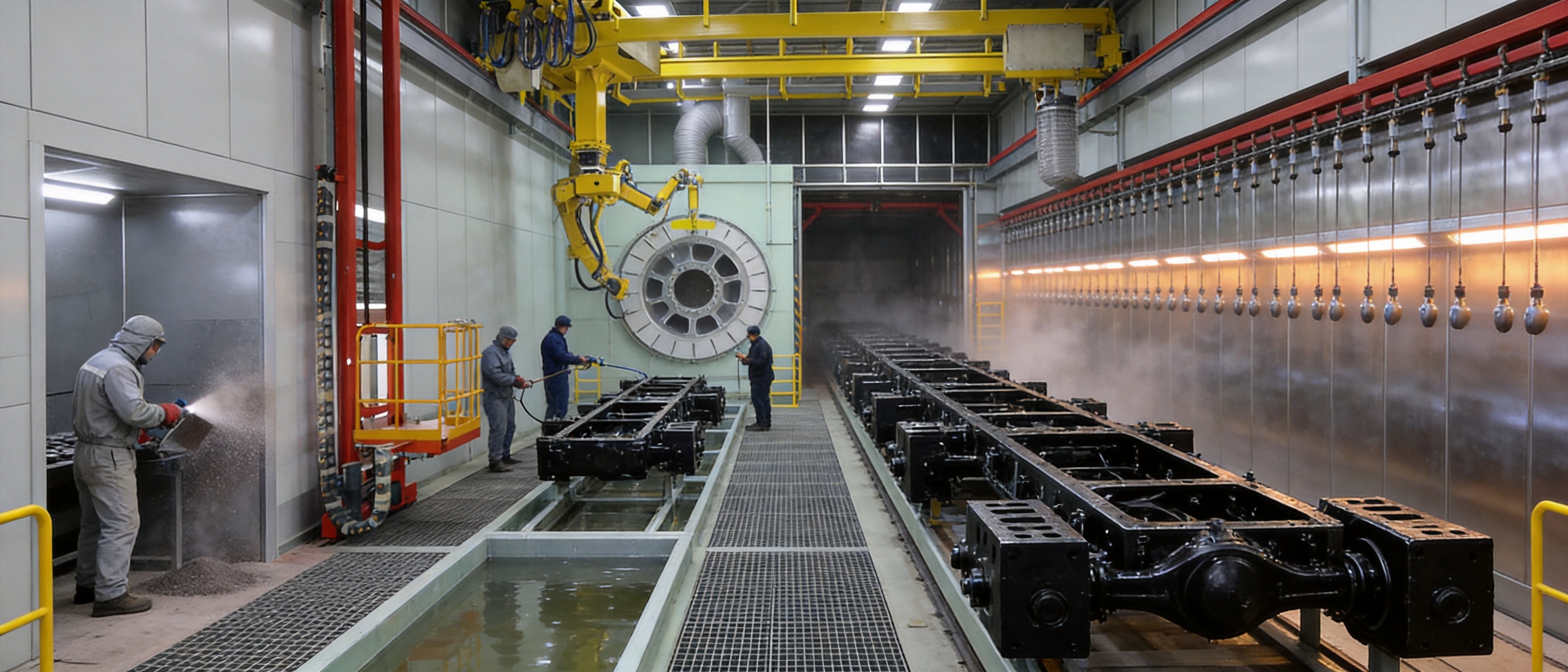
Manufacturing a heavy-duty coating line requires more than assembling standard components. The supplier must understand structural engineering, conveyor mechanics, thermal systems, spray technology, electrical control, environmental treatment, installation, and commissioning. Coordination among these disciplines determines whether the completed line operates smoothly.
Jiangsu Yue Ze Environmental Protection Equipment Co., Ltd. is located in Yancheng, Jiangsu, China, and operates a facility covering approximately 35,000 square meters. The company reports a registered capital of 58 million yuan and more than 40 years of combined experience in related equipment and industrial coating applications. Its manufacturing scope includes powder coating production lines, automotive counterweight spray lines, paint and bake booths, large-part grinding rooms, waste gas treatment equipment, infrared radiation drying systems, automatic conveyors, and intelligent coating lines.
The company’s experience with large castings includes the development of a hanging automatic painting process line for casting counterweight blocks in 2014. The process combined finishing, polishing, primer application, and topcoat application in a continuous production concept. This type of project experience is relevant to current heavy-part coating applications because it addresses the same core challenges: high load, irregular geometry, surface preparation, controlled spraying, and continuous material handling.
A substantial manufacturing facility provides practical advantages during equipment production. Large conveyor sections, booths, furnaces, platforms, and ducts can be fabricated and assembled in a controlled environment before delivery. Engineers can inspect dimensional accuracy, weld quality, component fit, and access for maintenance. Where necessary, the supplier can test equipment with representative parts or simulate the movement of large workpieces.
Yueze’s one-stop approach covers research and development, design, manufacturing, installation, commissioning, and customized service. This reduces the risk of communication gaps between separate suppliers. It also allows process decisions to be coordinated across the conveyor, spray booth, curing equipment, and environmental system.
Quality assurance should cover the entire equipment lifecycle, not only the final appearance of the machinery. Structural frames need dimensional checks and weld inspections. Conveyors require drive alignment, load testing, chain or rail inspection, and emergency stop verification. Furnaces require temperature testing, insulation inspection, and control calibration. Spray booths require airflow evaluation, filtration inspection, and grounding checks.
Electrical cabinets and control systems should be tested before shipment. This may include input and output verification, motor rotation checks, alarm tests, interlock tests, sensor calibration, and simulation of operating sequences. Early testing reduces commissioning time at the customer’s site.
Documentation is another important part of quality. Operating manuals, maintenance instructions, electrical drawings, spare-parts lists, safety procedures, and recommended inspection schedules help the customer operate the line correctly. Clear documentation also simplifies future troubleshooting and upgrades.
After installation, commissioning should include dry runs, loaded conveyor tests, heating tests, spray tests, and coating trials. Operators should receive training on daily operation, parameter adjustment, filter replacement, equipment cleaning, emergency response, and preventive maintenance.
A coating line represents a long-term production investment. Its operating value depends on availability, energy consumption, coating utilization, maintenance requirements, and the consistency of finished parts. Modular equipment with accessible components can reduce service time and make routine maintenance more manageable.
Daily inspections may include conveyor movement, hook condition, booth cleanliness, filter pressure, pump operation, spray-gun condition, furnace temperature, fan vibration, and alarm status. Operators should remove accumulated overspray and dust according to the equipment instructions. Filters must be replaced or cleaned at the recommended pressure differential or service interval.
Weekly and monthly maintenance can include lubrication, fastener checks, electrical cabinet inspection, sensor cleaning, fan and motor inspection, burner or heater checks, grounding verification, and calibration of temperature or pressure instruments. Preventive maintenance helps identify small faults before they cause a production stoppage.
Because large-part coating lines often operate with high loads and long cycles, spare parts planning is important. Recommended spare parts may include conveyor wear components, hooks, filters, pump seals, spray-gun parts, sensors, heating elements, and control relays. Keeping critical parts available can shorten recovery time.
The modular design also supports technical improvements. If the customer later needs higher output, better paint utilization, additional filtration, more precise inspection, or a different curing method, the equipment can be evaluated for an upgrade rather than replaced completely.
Manual spraying can be appropriate for prototypes, occasional repairs, or very low production volumes. However, it becomes difficult to control when the parts are large, heavy, and produced continuously. Operators may need to move or reposition the part several times, increasing labor intensity and the chance of missed surfaces.
A dedicated coating line reduces repeated handling. The workpiece can move through a planned sequence while the conveyor, pretreatment, spraying, curing, and exhaust systems operate in coordination. This improves production organization and reduces the time between operations.
Compared with a standard line designed for small or medium components, the heavy-duty system offers greater load capacity, more space, stronger fixtures, and more suitable curing performance. It is also better prepared for the rough surface and irregular geometry of castings.
Compared with a collection of independent booths and ovens, an integrated line provides better process continuity. The control system can coordinate each section, while the layout reduces unnecessary transport between operations. Integrated environmental equipment makes it easier to manage exhaust and filtration as a complete system.
Compared with low-cost equipment that uses fixed dimensions, a customized line provides a better match to actual production. The customer pays for the required capacity and functions rather than trying to adapt unsuitable equipment to oversized parts. This can reduce rework, coating waste, manual handling, and future modification costs.
Before ordering a coating line, the buyer should prepare accurate technical information. The maximum and minimum workpiece dimensions should include protrusions, fixtures, and movement clearance. Weight data should reflect the heaviest production condition rather than the average part. The center of gravity and preferred hanging points should also be identified.
The coating specification should state the coating type, number of layers, target film thickness, color requirements, curing temperature, curing time, corrosion-resistance standard, and expected service environment. If several coatings will be used, the supplier should understand their compatibility and process differences.
Production requirements should include annual output, hourly capacity, desired takt time, work shifts, batch size, product mix, and future expansion plans. These details determine conveyor speed, booth quantity, furnace length, spray-gun arrangement, and automation level.
Environmental information should include local emission regulations, permitted fuel types, available electrical capacity, water treatment requirements, ventilation restrictions, and factory noise limits. Early confirmation prevents expensive changes after equipment fabrication begins.
The buyer should also ask whether the supplier has completed comparable heavy-part projects. Experience with large castings, counterweight blocks, truck axles, frames, industrial equipment, or other oversized parts can reveal whether the supplier understands practical issues such as fixture stability, cavity coverage, furnace loading, and maintenance access.
The line can be designed for engineering castings, mining equipment castings, industrial castings, counterweight blocks, truck chassis, axles, engine parts, frames, fenders, wheel hubs, gearbox housings, and other large metal components. The final scope depends on the part dimensions, weight, surface condition, and coating process.
Yes. A shared line can process both product families when the conveyor capacity, booth dimensions, fixture design, spray coverage, curing capacity, and control recipes are selected for the full range of workpieces. Different products can use separate process programs and, where necessary, different loading fixtures.
Grinding removes casting sand, flash, burrs, sharp projections, and surface defects. It creates a more stable base for primer and reduces the chance that loose material or rough protrusions will cause peeling, pinholes, uneven film thickness, or premature corrosion.
Coverage depends on the part geometry and coating method, but the line can be equipped with adjustable spray guns, multiple spray angles, rotating fixtures, manual touch-up stations, and customized hanging positions. These features help reach internal and external surfaces, corners, gaps, and recessed areas.
The supplied product information identifies an adjustable range of approximately 50 to 200 micrometers. The achievable and recommended thickness depends on the coating material, number of layers, substrate, curing conditions, and customer specification. Film thickness should be verified using an appropriate inspection instrument.
Electrostatic spraying can be effective on grounded metal surfaces and may improve transfer efficiency and film uniformity. However, deep cavities and shielded areas may require additional spray angles or manual treatment. The final equipment configuration should be based on representative workpiece trials.
Convection, infrared radiation, or a combined system may be selected. Infrared radiation can be useful for directly heating coating layers and accelerating curing on heavy components, while convection provides broad, controlled heating. The correct choice depends on coating chemistry, part thickness, color, production speed, and required cure schedule.
Energy-saving measures may include insulated furnace panels, optimized airflow, heat recovery, intelligent temperature control, efficient burners or heaters, and infrared radiation drying where appropriate. The actual reduction depends on the operating schedule, part mass, environmental conditions, and equipment configuration.
Depending on the process, the line may include paint mist filtration, booth exhaust, waste gas treatment, grinding dust collection, water treatment, heat recovery, and noise-control measures. The final environmental system must be designed according to the coating materials, output, building conditions, and applicable regulations.
A modular line can often be expanded with automatic loading, additional spray stations, recipe management, inspection equipment, new filtration, improved conveying, or other functions. Future upgrades are easier when the original design includes adequate space, electrical capacity, control-system interfaces, and structural allowances.
The supplier normally needs part drawings or samples, maximum dimensions, weight, material, surface condition, hanging method, coating type, target film thickness, curing requirements, expected output, factory layout, available utilities, and local environmental requirements. Clear data improves the accuracy of the process design and quotation.
Jiangsu Yue Ze Environmental Protection Equipment Co., Ltd. provides integrated design, manufacturing, installation, commissioning, and customized equipment services. The project scope should be confirmed in the technical agreement, including transportation, site installation, operator training, trial production, documentation, and after-sales support.
A coating line for large castings and heavy truck parts must be engineered as a complete production system. Heavy-duty conveying, large workpiece access, thorough pretreatment, flexible spraying, reliable curing, environmental treatment, intelligent control, and convenient maintenance all contribute to final coating quality and production efficiency.
The most important advantage of a specialized line is its ability to address the actual difficulties of oversized and irregular components. It can support high loads without unstable movement, prepare rough casting surfaces before painting, cover complex geometries more effectively, and cure thick coating layers with controlled thermal performance. Its modular structure also allows the automation level, line length, spray stations, curing method, and environmental equipment to be adapted to the customer’s production plan.
With a large manufacturing facility, experience in heavy-part coating applications, integrated engineering capabilities, and a product range covering conveyors, booths, grinding rooms, curing systems, filtration equipment, and intelligent controls, Jiangsu Yue Ze Environmental Protection Equipment Co., Ltd. can provide a coordinated solution for manufacturers seeking reliable large-part surface treatment. The result is a more stable, efficient, environmentally responsible, and scalable coating operation.
1. Jiangsu Yue Ze Environmental Protection Equipment Co., Ltd., Product Information for Coating Lines for Large Castings and Heavy Truck Parts.
2. Jiangsu Yue Ze Environmental Protection Equipment Co., Ltd., Company Profile and Industrial Surface Treatment Equipment Overview.
3. General industrial guidance on surface preparation, liquid spraying, electrostatic coating, and curing of metal components.
4. General engineering practice for heavy-duty conveyors, spray booths, industrial ovens, infrared radiation drying, and waste gas treatment systems.
5. General environmental and occupational safety principles for industrial coating, grinding, filtration, ventilation, and thermal processing equipment.
Professional coating line specially designed for large castings and heavy truck parts, applicable to various large castings (engineering castings, mining equipment castings, industrial castings) and h...
See Details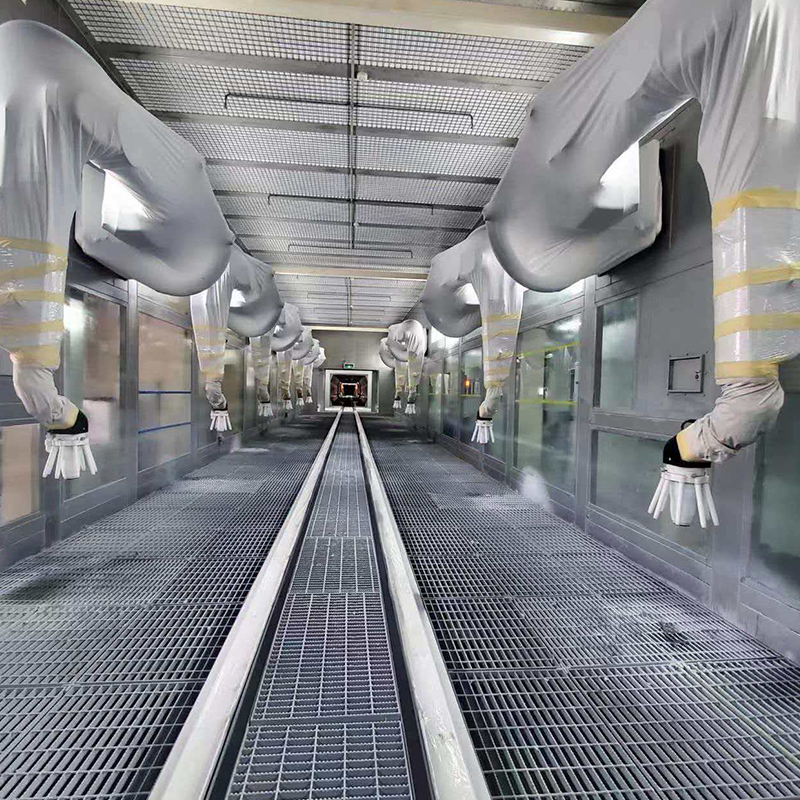
Professional coating line dedicated to truck body manufacturing and refurbishment, applicable to various truck types (heavy-duty truck, light-duty truck, pickup truck, van, commercial truck). Main typ...
See Details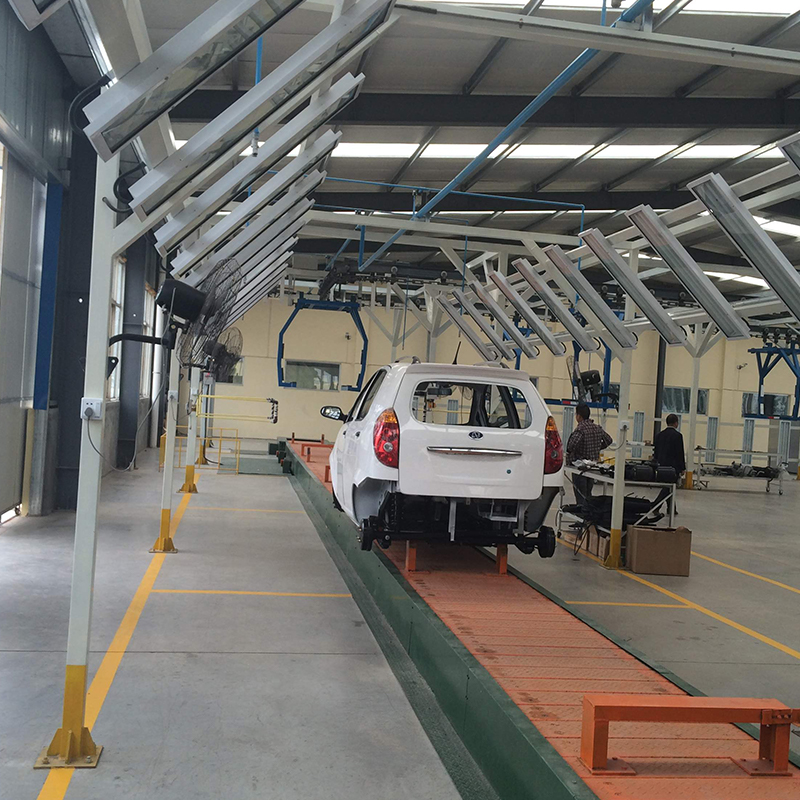
Professional electrophoresis coating line specially designed for electric vehicles (EVs), applicable to various EV types (passenger EV, commercial EV, new energy logistics vehicle) and EV components. ...
See Details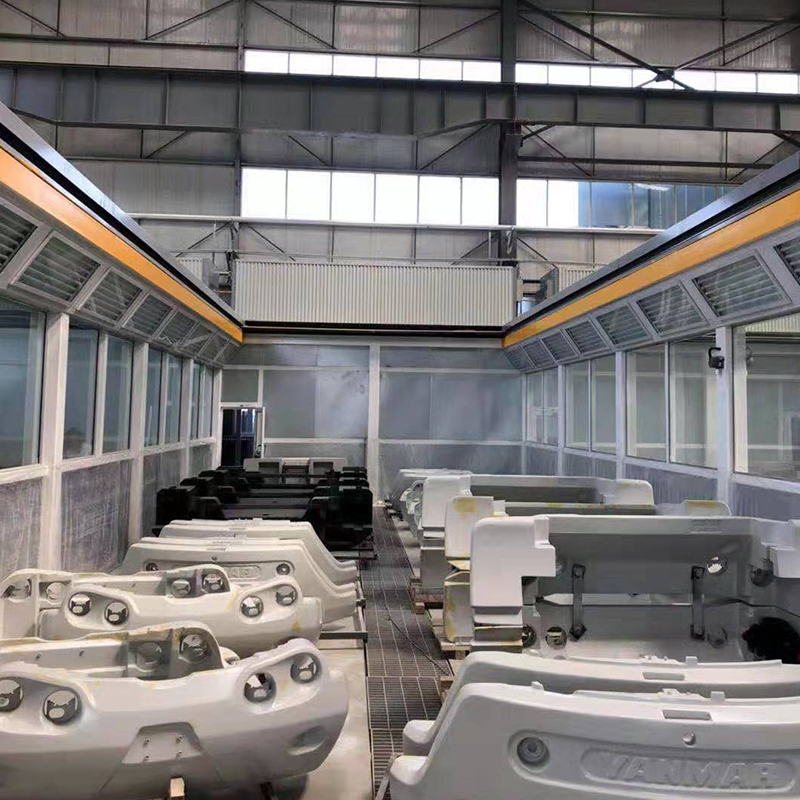
Professional spray coating line specially designed for car wheel manufacturing and refurbishment, applicable to various car wheel types (steel wheel, aluminum alloy wheel, forged wheel, cast wheel, pa...
See Details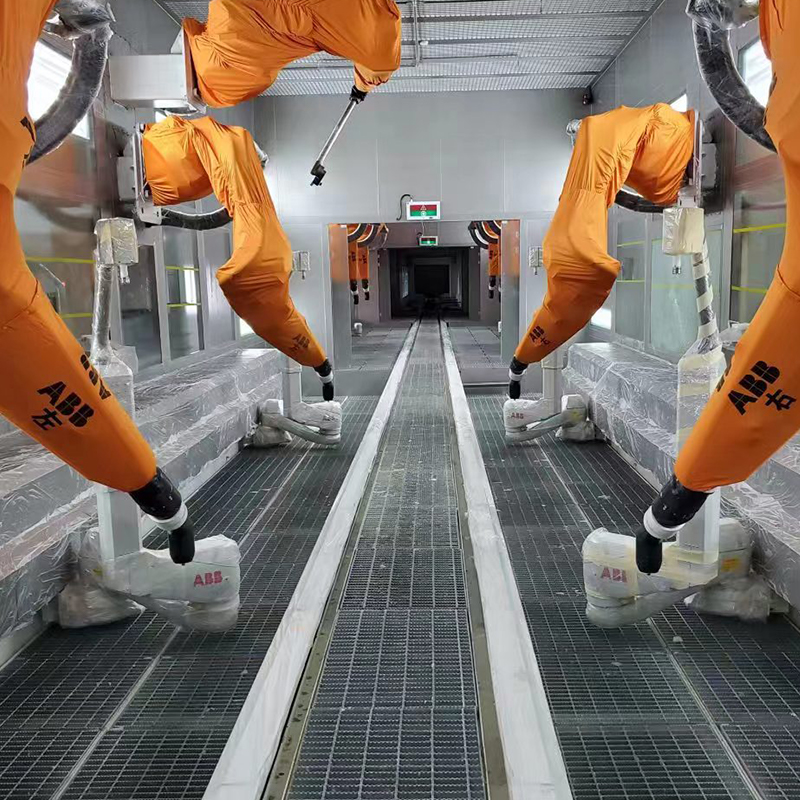
Professional spray coating line specially designed for motor casings, applicable to various motor casing types (electric vehicle motor casing, industrial motor casing, household motor casing, high-tem...
See Details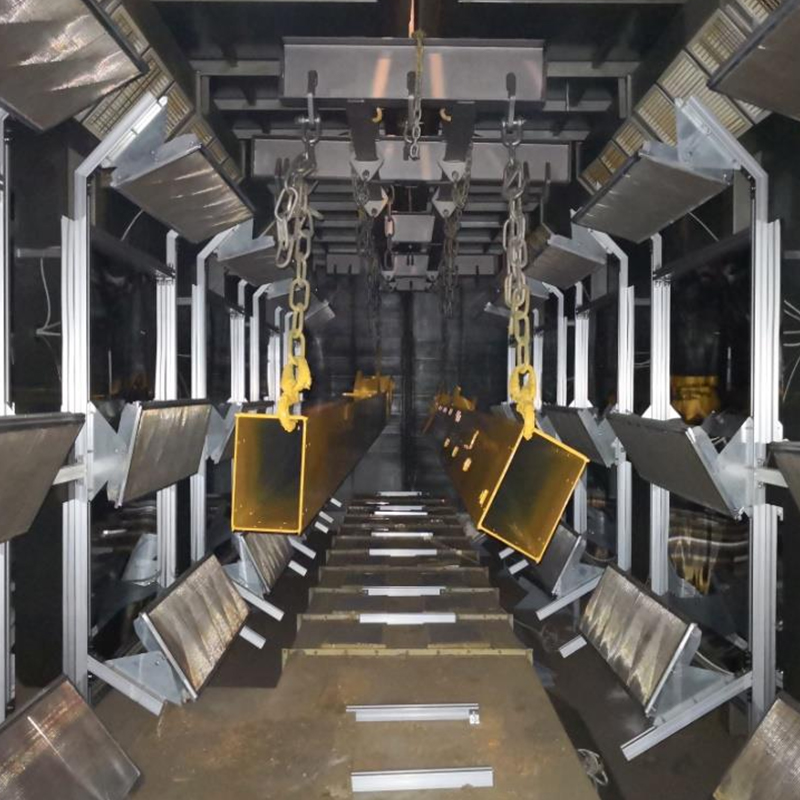
Professional spray coating line specially designed for car wheel manufacturing and refurbishment, applicable to various car wheel types (steel wheel, aluminum alloy wheel, forged wheel, cast wheel, pa...
See DetailsBuild Your Customized Industrial Coating System
Send us your workpiece information, production capacity, coating process, workshop layout, and environmental requirements. Yueze will help evaluate your project and develop a suitable coating, conveying, drying, and environmental treatment solution.
Main menu
Products
Contact Us
Company Address:
No. 12, Park Avenue, Shanggang Industrial Park, Jianhu, Yancheng City, Jiangsu Province
Message Us Right Now!

Follow us: