
 русский
 عربى
 Tiếng Việt

An automatic robotic spray booth is an intelligent, unmanned coating system. Equipped with a robot spraying system, constant temperature air circulation, and a high-efficiency exhaust filtration syste...
See Details
Yueze Environmental Protection provides one-stop compliant industrial surface treatment solutions with professional tech and fine craftsmanship.
 Get Inquiries
2026-09-24
Content
Automatic Robotic Spray Booth
Industrial coating is no longer limited to manually operated spray rooms and equipment that depends entirely on operator skill. As manufacturers face increasing pressure to improve surface quality, reduce labor costs, control material consumption, and meet stricter environmental requirements, automated coating equipment has become an important part of modern production. An automatic robotic spray booth combines robotic motion control, precision spraying, controlled airflow, filtration, product handling, and digital production management into one coordinated system.
Designed for continuous and standardized coating operations, this type of booth can be configured for a wide range of products, including large mechanical components, automotive parts, cast counterweight blocks, municipal facilities, art manhole covers, fabricated metal structures, construction machinery components, and other industrial workpieces. The system is especially valuable where production volume is high, part geometry is complex, and consistent appearance or film thickness is essential.
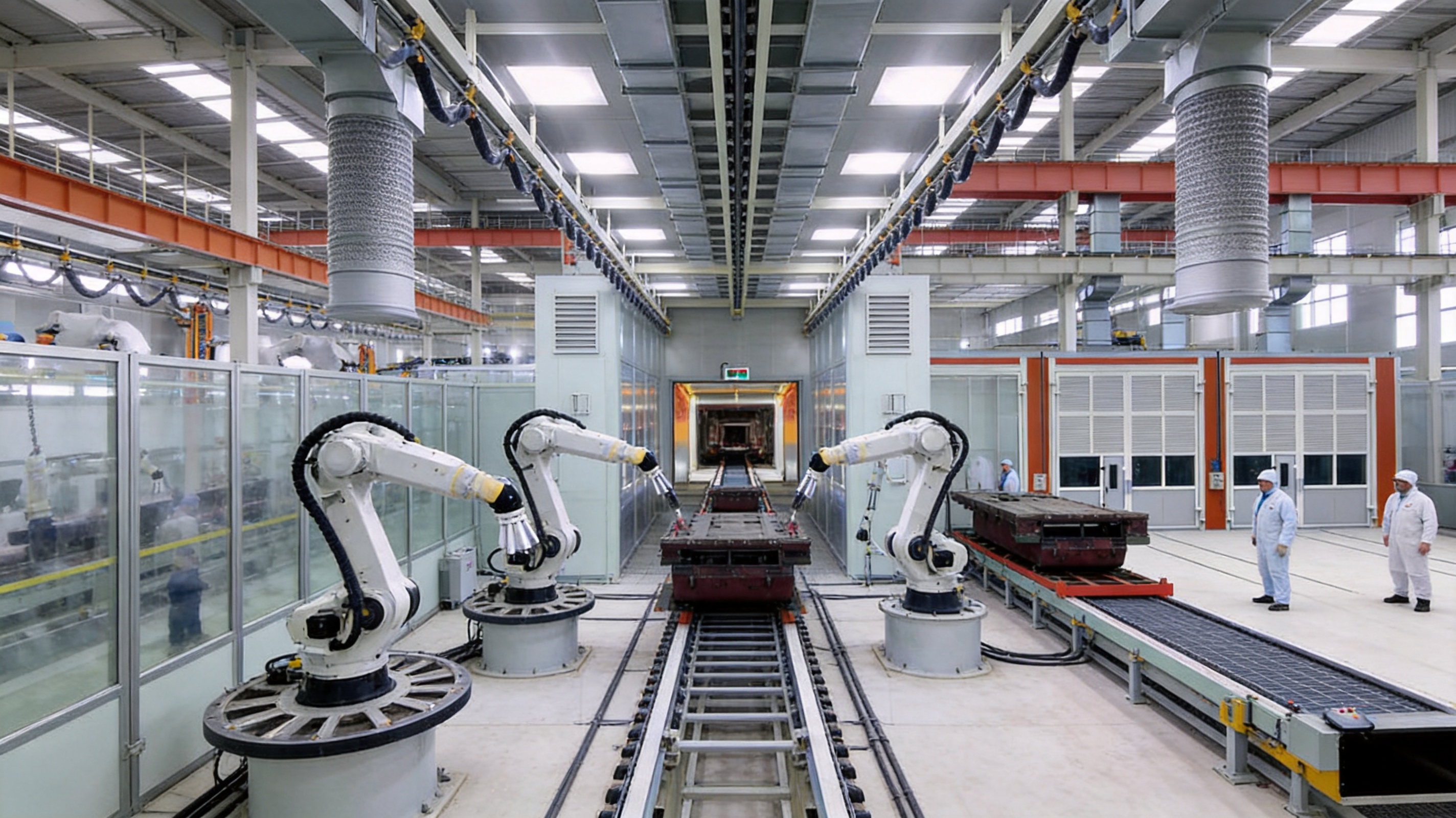
Unlike a basic spray booth that only provides an enclosed space and exhaust fan, an automatic robotic spray booth is a complete process platform. It can control the movement of the spray gun, the application rate, the spraying distance, the airflow condition, the workpiece position, and the production sequence. When connected with pretreatment equipment, drying or curing ovens, conveyors, inspection stations, and factory management software, it can form the core of a fully integrated coating production line.
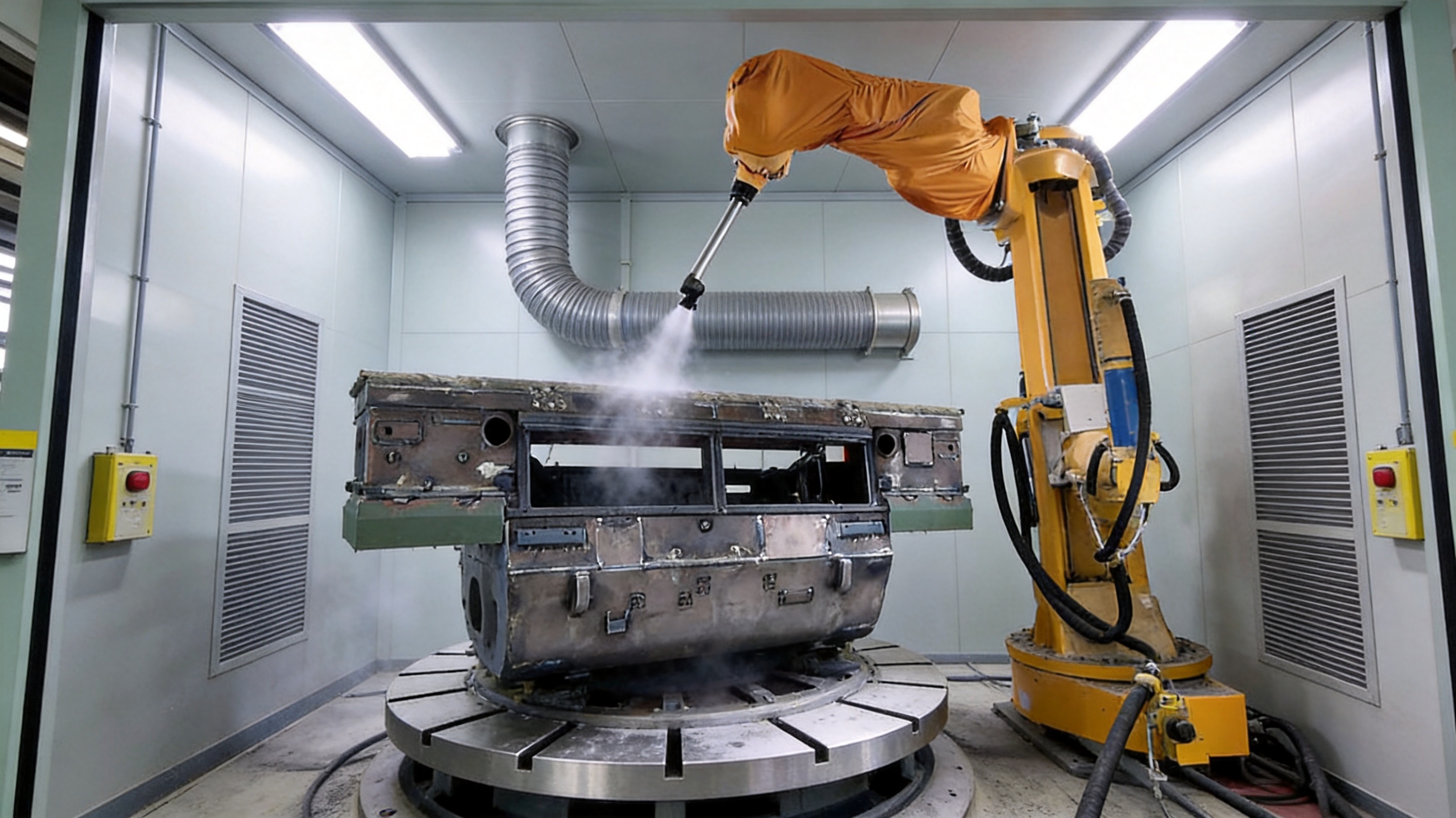
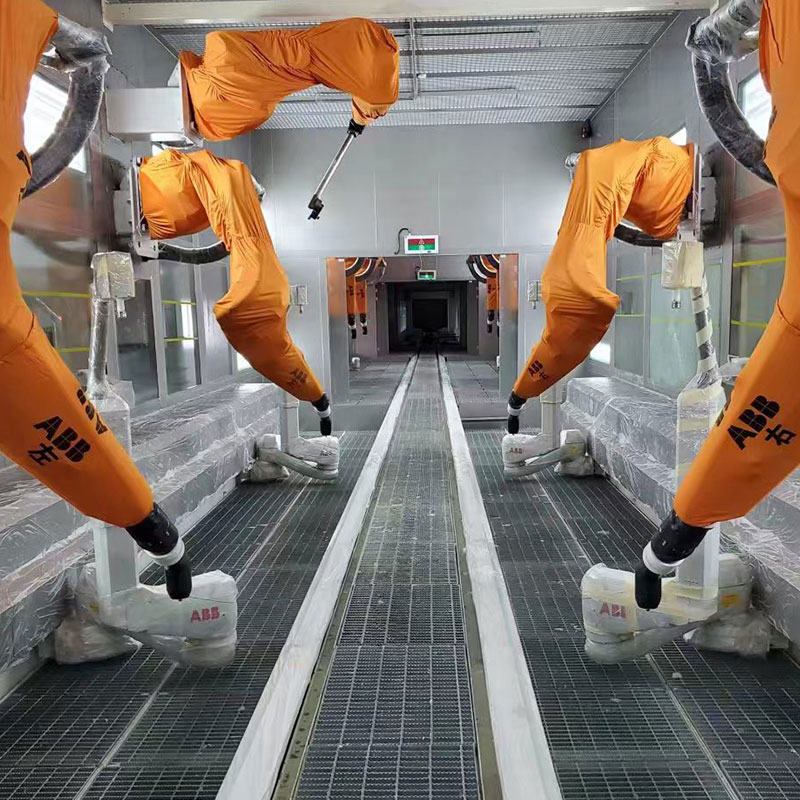
An automatic robotic spray booth is an enclosed coating system equipped with one or more industrial robots and an automatic spraying unit. The robot follows a programmed path around the workpiece, applying paint or powder at a controlled distance, angle, speed, and flow rate. The booth maintains a controlled working environment through ventilation, air circulation, exhaust treatment, and filtration.
The equipment may be designed for automatic powder coating, liquid painting, or a customized combination of coating processes. The exact spraying equipment depends on the coating material, product dimensions, required finish, production volume, and applicable safety standards. A powder application system may include electrostatic spray guns, powder pumps, cyclone separators, filter cartridges, and powder recovery equipment. A liquid painting system may use automatic paint guns, pressure tanks, pumps, mixing systems, solvent management equipment, and specialized exhaust filtration.
The primary objective is to separate the coating process from the variability of manual operation. An experienced operator can produce excellent results, but manual work is naturally affected by fatigue, movement speed, spray angle, hand distance, environmental conditions, and differences between workers. A programmed robot can repeat the same motion thousands of times while maintaining stable process parameters.
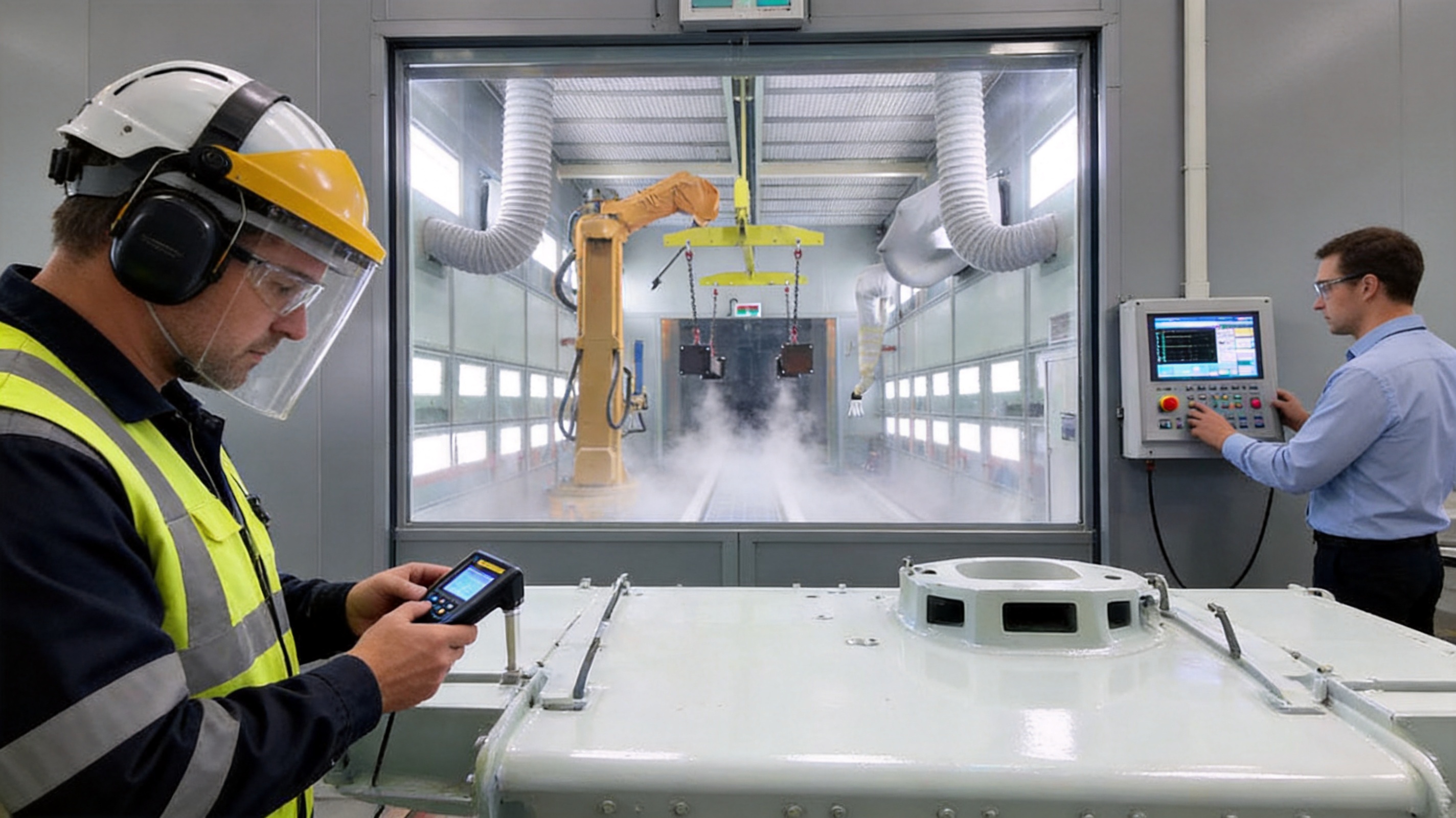
The booth also improves working conditions. During automatic operation, operators can remain outside the direct spraying area while the enclosure and negative-pressure ventilation system contain overspray, dust, and vapors. This helps reduce occupational exposure and supports a cleaner, safer, and more organized factory environment.
Industrial coating quality is determined by more than the quality of the paint or powder. Surface preparation, spray distance, application speed, atomization, airflow, film thickness, drying conditions, and curing temperature all influence the final result. If any of these factors fluctuate, the finished surface may show uneven color, sagging, orange peel, pinholes, insufficient coverage, excessive buildup, or poor adhesion.
Manual spraying can be appropriate for low-volume production, prototypes, repairs, and highly irregular workpieces. However, it becomes more difficult to control when the factory must process hundreds or thousands of similar parts. Repeating the same manual action for an entire shift can lead to fatigue and inconsistency. A robotic system addresses this challenge by applying a defined program to every workpiece.
Automation also helps manufacturers respond to labor shortages. Skilled coating operators require training and practical experience, and they may be difficult to recruit or retain. A robotic booth does not eliminate the need for qualified personnel, but it changes their role from constant manual spraying to programming, process monitoring, equipment adjustment, quality control, and maintenance. This allows a smaller team to manage a higher production volume while preserving process knowledge in digital programs.
For companies serving automotive, agricultural machinery, construction equipment, municipal infrastructure, and general industrial markets, production requirements are becoming more demanding. Customers expect stable appearance, reliable corrosion protection, traceable production, and predictable delivery. An automatic robotic spray booth supports these objectives by making the coating process more repeatable and easier to manage.
The robotic arm is the main motion unit. Six-axis robots are commonly selected because they can approach surfaces from multiple directions and orient the spray gun to match the geometry of the workpiece. Additional axes may be used when the product is especially large, deep, long, or difficult to access.
The spray gun is selected according to the coating process. For powder coating, the equipment may use electrostatic charging to improve transfer efficiency and encourage powder adhesion to grounded workpieces. For liquid painting, the system may use air spray, airless spray, air-assisted airless spray, or another application method. The robot controller coordinates gun activation, material flow, atomizing air, electrostatic voltage, and movement speed.
Robotic spraying is most effective when the workpiece is presented to the robot in a consistent position. A positioning system may include a rotating fixture, indexing table, lifting device, tilting mechanism, or synchronized conveyor. Rotation allows the robot to access the sides and rear surfaces of a product without requiring overly complex robotic movement.
Fixtures must be designed carefully. They should hold the workpiece securely, avoid blocking important surfaces, permit electrical grounding where necessary, and withstand the coating environment. For products with different dimensions, adjustable fixtures or quick-change tooling can improve production flexibility.
The booth structure forms the controlled spraying environment. Its dimensions are determined by the largest workpiece, robot reach, fixture movement, maintenance access, and required safety clearance. Internal surfaces should be designed to reduce overspray accumulation and simplify cleaning.
Depending on the process, the booth may include insulated panels, washable internal surfaces, lighting, access doors, observation windows, safety interlocks, maintenance platforms, and explosion-protection features. The enclosure must also support stable airflow so that overspray is captured without disturbing the spray pattern.
Ventilation is essential for both coating quality and worker safety. A properly designed system maintains negative pressure inside the booth, preventing airborne coating particles or paint mist from escaping into the factory. Exhaust air passes through suitable filtration equipment before discharge or further treatment.
For powder coating, cyclone separators and filter cartridge recovery systems can capture reusable powder and reduce material waste. For liquid painting, filtration may involve paint arrestor filters, dry filters, water-wash systems, activated carbon, or additional volatile organic compound treatment, depending on the coating material and local requirements.
The control system stores spray programs and coordinates the robot, conveyor, workpiece positioner, spray equipment, ventilation system, alarms, and safety devices. Operators can select the appropriate program for each product model and monitor the operating status through a human-machine interface.
Advanced configurations can record production parameters such as program number, spray duration, conveyor speed, material flow, pressure, voltage, alarm history, and maintenance information. When connected to a manufacturing execution system, the booth can support digital production scheduling, product traceability, and process reporting.
The most important advantage of robotic spraying is repeatability. The robot can maintain a defined spray distance and follow the same programmed path for each workpiece. This helps control film thickness, coverage, color uniformity, and surface appearance.
Manual application often creates variation between operators or even between different shifts performed by the same operator. A robot does not become tired or change its technique during a long production cycle. When the spray program and process parameters have been validated, the same method can be repeated with a high degree of consistency.
Consistent film thickness can reduce rework and improve the use of coating materials. Excessive coating increases cost and may create defects, while insufficient coating may reduce corrosion protection or fail customer specifications. Robotic control helps move the process closer to the desired target.
Many industrial parts contain cavities, recesses, inner surfaces, sharp edges, narrow spaces, brackets, ribs, and irregular profiles. These areas are difficult to coat manually because the operator may not be able to maintain the correct angle or distance. A multi-axis robotic arm can approach the workpiece from several directions and execute a carefully designed trajectory.
For deep cavities and inner surfaces, the system can be programmed with specific entry and withdrawal movements. For sharp edges, the robot can adjust its angle and speed to reduce excessive buildup. For large structures, synchronized movement between the robot and positioner can expose hidden surfaces while maintaining a stable spraying relationship.
Robotic programming does not automatically guarantee perfect coverage. The fixture, workpiece orientation, spray pattern, material characteristics, and number of guns must be considered during commissioning. However, the robot provides the motion flexibility and repeatability needed to achieve coverage that would be difficult to maintain manually.
Automatic spraying uses a defined working cycle. Once the loading, spraying, unloading, and transfer sequence has been optimized, the equipment can operate continuously with limited intervention. Spray speed, overlap, and movement path can be set according to the coating requirements and production rhythm.
For standardized parts, robotic equipment can significantly increase output compared with manual spraying. It is particularly effective when the same product or a family of similar products is produced in large quantities. Multiple programs can also be stored for mixed production, allowing operators to change from one product model to another without completely rebuilding the process.
Higher productivity also improves planning. A factory can estimate cycle time more accurately because automatic programs follow a predictable sequence. This makes it easier to coordinate pretreatment, drying, curing, inspection, packaging, and delivery schedules.
A robotic spray booth reduces the amount of continuous manual spraying required. Operators can focus on loading, unloading, inspection, program selection, equipment supervision, and maintenance. This can reduce exposure to difficult working conditions and help factories use skilled personnel more efficiently.
The system is not simply a labor replacement device. Its real value comes from transferring repetitive operations to an automated platform while allowing employees to perform higher-value tasks. Programming and process engineering remain essential, particularly when the factory handles multiple part geometries or coating materials.
Precise application reduces unnecessary overspray. In powder coating applications, a cyclone and filter cartridge recovery system can collect suitable overspray for controlled reuse, depending on the powder type, color management requirements, and quality policy. The supplied product information indicates that a properly configured recovery system can achieve a powder utilization rate of more than 98 percent under suitable operating conditions.
Actual recovery performance depends on many factors, including product shape, powder characteristics, spray settings, booth airflow, filter condition, color changes, and the percentage of powder that can be reused. Nevertheless, robotic movement and controlled application generally provide a strong foundation for reducing material waste compared with inconsistent manual spraying.
The enclosed booth and negative-pressure design help contain coating particles and overspray. Proper ventilation prevents contaminants from spreading through the factory and helps maintain a more stable spraying environment. Operators are not required to stand directly in the spray cloud during normal automatic operation.
Safety equipment may include door interlocks, emergency-stop circuits, fire detection, grounding monitoring, pressure monitoring, overload protection, and access control. The exact configuration must be selected according to the coating material, equipment type, national regulations, and site conditions.
Environmental protection is also improved when overspray is captured efficiently and exhaust air is treated through appropriate filtration. A complete environmental solution may include waste gas purification, powder recovery, paint mist separation, and other treatment equipment matched to the production process.
Modern factories rarely produce only one product forever. Customer orders may require different sizes, colors, shapes, or coating specifications. A robotic booth can store multiple programs, each containing the movement path and spraying parameters for a specific product.
Program selection can be performed through the control interface, barcode system, production order, or manufacturing software. With suitable tooling and process planning, product changeover can be completed more quickly than rebuilding a manual process for every new part. This flexibility is valuable for contract manufacturers and companies serving several industrial sectors.
There is no universal robotic spray booth that is ideal for every factory. The system must be designed according to product dimensions, weight, geometry, coating type, production volume, required finish, available floor space, and future expansion plans.
| Production Scenario | Recommended Configuration | Primary Benefit | Important Design Consideration |
|---|---|---|---|
| High-volume single product | Fixed robotic program with automated conveyor | Stable cycle time and maximum repeatability | Optimize fixtures and loading rhythm |
| Mixed product production | Multi-program robot with adjustable fixtures | Fast changeover between product models | Manage program selection and product identification |
| Large workpieces | Long-reach robot with positioner or synchronized axis | Access to broad surfaces and hidden areas | Coordinate robot reach with booth dimensions |
| Complex geometry parts | Six-axis or multi-axis robot with rotating positioner | Improved coverage of cavities and irregular surfaces | Validate paths through simulation and trial spraying |
| Powder coating operation | Electrostatic guns with cyclone and cartridge recovery | High transfer efficiency and material recovery | Control grounding, color changes, and filter maintenance |
| Liquid painting operation | Automatic paint supply and exhaust filtration system | Stable application and reduced operator exposure | Match filtration to paint chemistry and emissions |
The robot must be able to reach every required surface without collision. A workpiece that appears small from the outside may require a large working envelope if it has deep cavities or multiple sides. The designer should consider the robot base position, fixture rotation, gun dimensions, hose routing, maintenance access, and safe clearance.
For large parts, a floor-mounted robot, overhead robot, or synchronized linear axis may be appropriate. For smaller parts, a compact robot and indexing table may deliver faster cycles. The final selection should be based on a complete motion study rather than only the external dimensions of the product.
High-volume lines require careful calculation of takt time. The design must account for loading, positioning, spraying, drying, unloading, inspection, and possible rework. If the spray booth is faster than the pretreatment or curing stage, the rest of the line may become a bottleneck. A balanced production line is more effective than an isolated high-speed booth.
For lower-volume or highly varied production, flexibility may be more valuable than maximum speed. In that situation, quick-change fixtures, accessible programming, and easy cleaning can have a greater impact on total operating cost than a complex multi-robot arrangement.
Powder and liquid coating systems have different equipment, airflow, recovery, cleaning, and safety requirements. Even within powder coating, different colors and formulations may require specific changeover procedures. Liquid coatings may require controlled paint mixing, viscosity management, solvent handling, and exhaust treatment.
The booth should be designed around the coating specification rather than selected as a generic enclosure. Important data includes required film thickness, surface appearance, curing conditions, coating solids, flash-off time, color frequency, and allowable overspray. The equipment manufacturer should receive representative workpieces or accurate drawings before final engineering.
A robotic spray booth is only as reliable as the engineering behind it. The manufacturer must understand not only robot programming but also airflow, coating technology, mechanical fabrication, electrical control, safety systems, conveyor design, environmental treatment, and production-line integration.
Jiangsu Yue Ze Environmental Protection Equipment Co., Ltd. is located in Yancheng, Jiangsu, China, and covers approximately 35,000 square meters. With registered capital of 58 million yuan and more than 40 years of experience, the company provides integrated industrial surface-treatment and environmental-protection equipment. Its product range includes powder coating lines, paint and bake booths, large-part grinding rooms, automated conveying systems, waste gas treatment equipment, infrared radiation drying systems, intelligent coating lines, automotive counterweight spray lines, and other customized production equipment.
The company’s experience extends beyond individual booths. It can develop complete process lines that connect surface preparation, coating, drying, curing, conveying, inspection, and environmental treatment. This broader capability is important because a booth must work as part of the customer’s production system. A technically advanced booth cannot deliver its intended value if the conveyor speed, pretreatment condition, oven capacity, or exhaust treatment is not properly coordinated.
Integrated research and development allows the equipment to be adapted to different workpieces and production conditions. Engineering teams can evaluate the part geometry, coating method, production rhythm, factory layout, and environmental requirements before selecting the final configuration.
The company’s project experience includes a hanging automatic painting process line for cast counterweight blocks developed in 2014. This type of project requires coordination between workpiece finishing, polishing, primer application, topcoat application, conveying, drying, and quality control. Experience with complete process sequences supports the development of more practical robotic booth solutions.
Manufacturing quality affects booth durability, sealing, airflow stability, maintenance convenience, and long-term operating cost. Panel dimensions, structural rigidity, internal smoothness, filter access, electrical cabinet assembly, and protective finishing should all be controlled during production.
A capable manufacturer can fabricate the booth structure, conveyor components, ducts, platforms, fixtures, recovery equipment, and supporting systems under coordinated quality procedures. This reduces the risk of dimensional mismatch between components supplied by different vendors. It also simplifies communication when changes are required during installation or commissioning.
Before a robot is commissioned for mass production, the spray path should be tested through offline programming, digital simulation, physical trial spraying, or a combination of these methods. Simulation can identify potential collisions, unreachable surfaces, excessive wrist rotation, inefficient movements, and interference with fixtures.
Trial spraying confirms whether the programmed path delivers the required coverage and film thickness. The robot program may then be adjusted for speed, overlap, gun angle, trigger timing, and product orientation. This engineering stage is essential for complex workpieces and should not be treated as a simple installation task.
A complete project may include equipment transportation, foundation preparation, booth assembly, duct installation, electrical connection, robot programming, conveyor synchronization, safety testing, coating trials, operator training, and performance acceptance. The manufacturer’s ability to manage these stages contributes greatly to the final result.
Commissioning should verify key performance indicators such as cycle time, spray coverage, film thickness, exhaust operation, filter performance, powder recovery, alarm response, emergency-stop function, and interlock operation. Training should cover daily operation, program selection, cleaning, filter replacement, grounding checks, fault diagnosis, and preventive maintenance.
A typical automated coating line begins with loading. Workpieces are placed on hangers, fixtures, pallets, or a conveyor system. Depending on the product, the parts may pass through cleaning, degreasing, rinsing, phosphating, drying, grinding, or other pretreatment stages before entering the robotic spray booth.
When the workpiece reaches the spraying position, sensors or a production control system confirm its presence and identify the required program. The robot and positioner move to their starting positions. Ventilation and filtration equipment operate at the required condition, and the spray cycle begins after all safety signals are confirmed.
During spraying, the robot follows its programmed trajectory while the gun applies coating to the specified surfaces. The positioner may rotate or tilt the part to expose areas that would otherwise be inaccessible. Airflow captures overspray and transfers it to the filtration or recovery system.
After spraying, the workpiece exits the booth and moves to a leveling, drying, or curing stage. In powder coating, the powder must be heated until it melts, flows, and cures into a continuous film. In liquid painting, the coating may pass through flash-off and baking stages depending on the material system. The completed part is then inspected and transferred to the next production stage.
This sequence can be integrated with overhead conveyors, pretreatment equipment, curing ovens, infrared radiation systems, inspection stations, and MES software. The result is a coordinated production line rather than a stand-alone booth.
Environmental performance should be considered during the initial design stage. Exhaust volume, filtration efficiency, powder recovery, paint mist capture, waste handling, and noise levels all affect the suitability of the installation. Local regulations may define requirements for emissions, fire protection, ventilation, electrical equipment, and hazardous-area classification.
Negative pressure inside the booth helps prevent overspray from escaping, but it must be balanced correctly. Excessive airflow may disturb the spray pattern, increase material consumption, or create uneven deposition. Insufficient airflow may allow contaminants to remain in the booth or escape through openings. Airflow testing and filter maintenance are therefore important parts of reliable operation.
Powder coating systems require special attention to grounding, static electricity, powder accumulation, filter condition, and ignition prevention. Liquid paint systems require controls for flammable vapors, solvent storage, electrical safety, and waste handling. The final design must be based on the actual coating materials and applicable safety codes.
Operators should receive clear procedures for cleaning the booth, checking filters, inspecting grounding points, removing accumulated material, handling waste, and responding to alarms. Automation improves safety, but it does not remove the need for disciplined operating practices.
The initial cost of a robotic spray booth is normally higher than that of a simple manual booth. The investment may include the robot, spray equipment, booth structure, ventilation, filtration, positioner, conveyor, electrical controls, programming, installation, and training. However, purchase price alone does not represent the total economic value of the system.
Operating savings can come from reduced labor requirements, lower coating waste, fewer quality defects, reduced rework, more stable production scheduling, and improved equipment utilization. A consistent process may also reduce customer complaints and warranty-related costs.
The payback period depends on annual production volume, labor rates, product mix, coating consumption, defect rate, and operating hours. The supplied company information indicates that cost recovery is commonly targeted within one to two years under suitable production conditions. This should be treated as a project-specific estimate rather than a universal guarantee. A factory should prepare a financial model using its own production data before making an investment decision.
Long-term cost also depends on maintenance. Filters, spray guns, hoses, seals, fixtures, sensors, and conveyor components require periodic inspection or replacement. A system designed for easy access and preventive maintenance can reduce downtime and extend service life.
Robotic spraying should be supported by a structured quality-control program. Before production begins, the factory should define the required film thickness, appearance, adhesion, color, gloss, corrosion resistance, and curing performance. The inspection method should match the customer specification and coating technology.
Film thickness can be measured using suitable gauges. Adhesion may be evaluated through cross-cut or pull-off testing. Appearance inspection can identify runs, sags, pinholes, exposed areas, roughness, color variation, and contamination. Curing performance may be checked through solvent resistance, hardness, or other approved methods.
Process parameters should be controlled as carefully as the robot path. These may include spray voltage, powder flow, paint flow, atomizing pressure, booth airflow, conveyor speed, workpiece grounding, oven temperature, and curing time. Recording these parameters helps identify the cause of defects and supports traceability.
When product specifications change, the relevant robot program should be reviewed and validated. Operators should not make uncontrolled path or parameter changes during production. A program-management procedure can prevent accidental overwriting and ensure that only approved versions are used.
Routine maintenance keeps the booth operating safely and consistently. Daily tasks may include cleaning the booth interior, checking filters, inspecting the spray gun, confirming grounding, removing powder or paint accumulation, and reviewing alarms. Weekly or monthly tasks may include checking seals, hoses, robot lubrication, conveyor components, sensors, electrical connections, and ventilation performance.
Filter cartridges should be replaced or cleaned according to pressure drop and manufacturer recommendations. Dirty filters can reduce airflow and affect coating quality. Spray guns should be inspected for wear, blockage, charging problems, or unstable material delivery. Robot axes and positioners should be checked for abnormal vibration, noise, or movement.
Preventive maintenance is preferable to emergency repair. A planned maintenance schedule can identify component wear before it causes production stoppage. Critical spare parts should be stocked according to lead time and operating conditions. Remote technical support may also help reduce troubleshooting time.
Start by identifying the workpiece dimensions, weight, material, surface condition, coating type, color range, required finish, daily output, working hours, and future products. Drawings, photographs, sample parts, and process specifications should be collected at this stage.
The available space must accommodate loading, pretreatment, spraying, drying, curing, inspection, packaging, maintenance, and safe operator movement. Ceiling height, floor strength, utility connections, ventilation routes, and fire-protection provisions should be evaluated before the equipment layout is finalized.
The project may require one robot, several robots, automatic workpiece rotation, automatic loading and unloading, barcode identification, or full-line integration. The best configuration depends on production volume and product variety. Over-automation can increase complexity, while under-automation may leave important bottlenecks unresolved.
Representative parts should be used for spray trials whenever possible. Testing can confirm coverage, film thickness, color, cycle time, material consumption, and curing results. Trial testing also reveals whether changes are needed in the fixture, robot path, spray gun, or booth airflow.
After installation, the system should be commissioned under actual production conditions. Operators, maintenance technicians, and supervisors should receive role-specific training. Acceptance should be based on documented performance criteria rather than visual operation alone.
The booth can be configured for mechanical parts, automotive components, cast counterweight blocks, municipal facilities, art manhole covers, fabricated structures, agricultural machinery parts, construction equipment components, and other industrial workpieces. The final suitability depends on product dimensions, weight, geometry, coating material, and required production cycle.
Yes, but the spraying unit, filtration system, ventilation design, safety equipment, and material-handling system must be selected for the specific process. Powder coating generally requires electrostatic equipment and powder recovery, while liquid painting may require paint pumps, mixing systems, solvent management, and specialized exhaust treatment.
The robot repeats a programmed path with controlled speed, angle, distance, and trigger timing. This reduces the variation associated with manual spraying and helps maintain more uniform film thickness and surface coverage from one workpiece to the next.
Yes. Multiple spray programs can be stored in the control system. When combined with adjustable fixtures, product identification, and suitable workpiece positioning equipment, the booth can switch between different models more efficiently than a process that must be manually re-established for every product.
It can handle many complex shapes when the robot reach, number of axes, fixture design, and spray path are properly engineered. Deep cavities may require special gun orientation, part rotation, additional axes, or multiple spray passes. Trial testing is recommended before final approval.
No. Operators and technicians are still required for loading, unloading, program selection, inspection, cleaning, maintenance, troubleshooting, and process supervision. Automation reduces repetitive manual spraying and exposure to the coating environment, but trained personnel remain essential.
Negative pressure helps keep airborne coating particles and paint mist inside the booth so that they can be captured by the filtration system. This supports a cleaner factory environment and reduces operator exposure, provided the ventilation and filtration equipment are correctly designed and maintained.
Recovery performance depends on powder type, part geometry, airflow, spray settings, filter condition, color management, and reuse requirements. The supplied product information states that a cyclone and filter cartridge system can achieve powder utilization above 98 percent under suitable conditions. Actual results should be confirmed through project testing and operating data.
Important information includes product drawings or samples, dimensions, weight, material, coating type, color range, required film thickness, production volume, cycle time, available floor space, conveyor preference, pretreatment requirements, curing conditions, environmental standards, and the desired level of automation.
The payback period varies according to labor costs, operating hours, production volume, material savings, defect reduction, and equipment price. A one- to two-year recovery period may be achievable for suitable high-volume applications, but every project should be evaluated using its own financial and production data.
Yes. The system can be designed to connect with overhead conveyors, pretreatment systems, drying ovens, curing ovens, inspection stations, and MES or factory-control systems. Interface requirements should be reviewed early so that mechanical, electrical, and control systems are compatible.
A suitable partner should understand robotics, coating technology, booth construction, airflow, filtration, conveyors, environmental protection, electrical control, installation, commissioning, and after-sales support. Experience with complete coating lines is especially valuable because it helps ensure that the robotic booth performs effectively within the entire production process.
An automatic robotic spray booth is a strategic production asset for manufacturers seeking better coating consistency, higher productivity, improved safety, and lower long-term operating costs. By combining a programmable robot with controlled spraying, workpiece positioning, ventilation, filtration, recovery, and digital control, the system transforms coating from a highly variable manual task into a repeatable industrial process.
Its greatest advantages appear in high-volume and standardized production, but flexible programming also makes it suitable for factories handling multiple products. Complex workpieces can be approached from several directions, while fixed spray distance, speed, and angle help reduce film-thickness variation and rework. Enclosed operation and negative-pressure ventilation help protect workers and control overspray, while powder recovery and precise application can reduce material consumption.
The success of a robotic booth depends on correct engineering. Robot reach, fixture design, coating material, airflow, filtration, conveyor rhythm, curing conditions, safety systems, and maintenance access must be considered together. A manufacturer with broad experience in powder coating lines, paint and bake booths, environmental equipment, automated conveying systems, and customized production lines can provide more than a standard machine. It can provide a coordinated solution designed around the customer’s products and production objectives.
With more than 40 years of industry experience, integrated research and development, manufacturing capabilities, installation support, and customized engineering services, Jiangsu Yue Ze Environmental Protection Equipment Co., Ltd. is positioned to support complete industrial surface-treatment projects. Its experience with automated painting process lines, intelligent coating equipment, waste gas treatment, drying systems, and conveyor integration provides a strong foundation for developing reliable robotic spray booth solutions.
For a factory considering automation, the best starting point is a detailed evaluation of its products, output requirements, coating specifications, labor structure, factory layout, and future expansion plans. When the system is correctly matched to these requirements, an automatic robotic spray booth can improve quality, stabilize production, reduce waste, and create a safer and more competitive manufacturing operation.
1. Jiangsu Yue Ze Environmental Protection Equipment Co., Ltd., Automatic Robotic Spray Booth Product Information and Technical Overview.
2. Jiangsu Yue Ze Environmental Protection Equipment Co., Ltd., Powder Coating Line and Automated Surface-Treatment Equipment Company Profile.
3. General industrial coating process principles covering spray application, film-thickness control, powder recovery, ventilation, and curing.
4. General robotic automation engineering practices for industrial spray application, workpiece positioning, path programming, and production-line integration.
5. General environmental and occupational-safety principles for enclosed spray booths, exhaust filtration, negative-pressure ventilation, and coating material handling.
An automatic robotic spray booth is an intelligent, unmanned coating system. Equipped with a robot spraying system, constant temperature air circulation, and a high-efficiency exhaust filtration syste...
See Details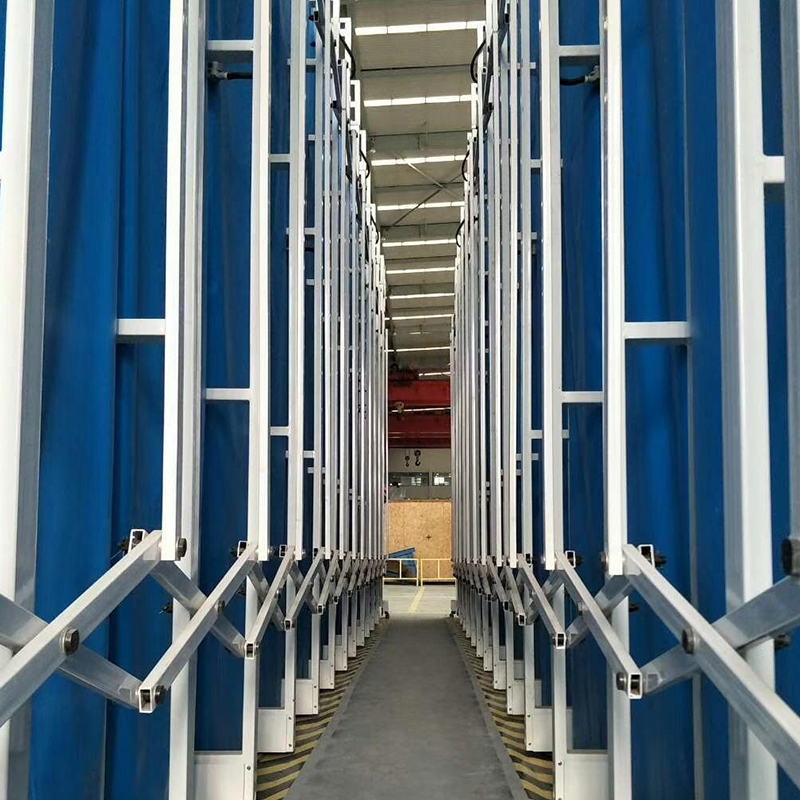
The retractable mobile spray & sanding booth is a flexible, space-saving, and multi-functional coating workstation. With a telescopic movable structure and integrated dust & paint mist filtrat...
See Details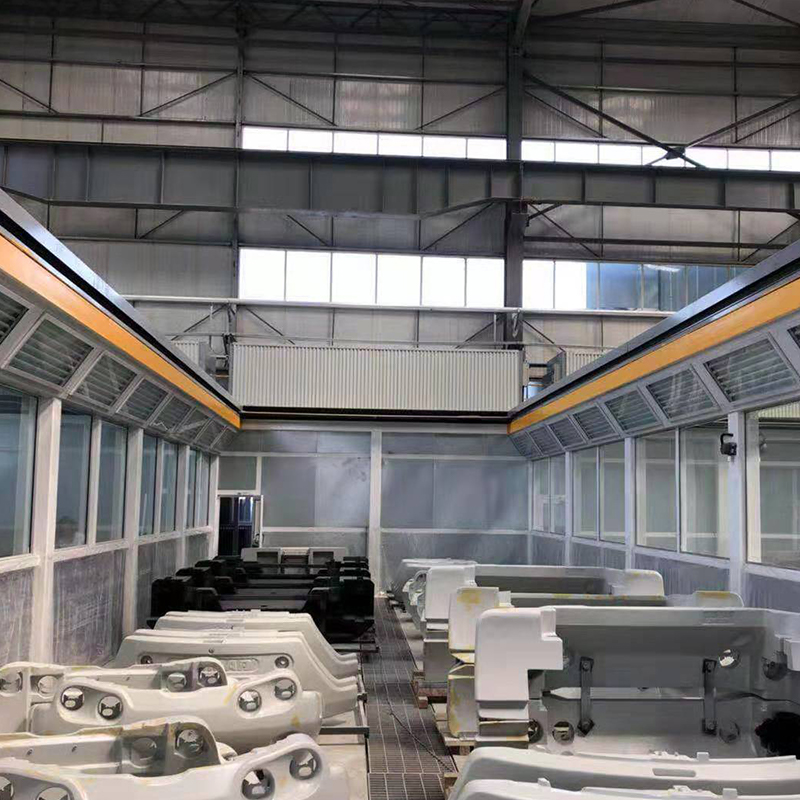
The retractable mobile spray & sanding booth is a flexible, space-saving, and multi-functional coating workstation. With a telescopic movable structure and integrated dust & paint mist filtrat...
See Details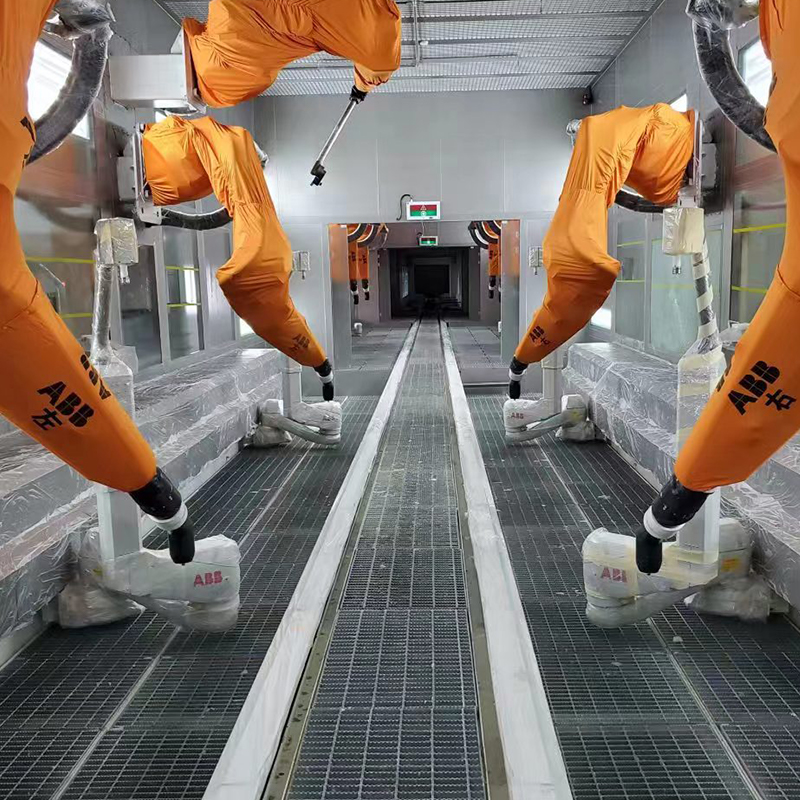
Professional spray coating line specially designed for motor casings, applicable to various motor casing types (electric vehicle motor casing, industrial motor casing, household motor casing, high-tem...
See Details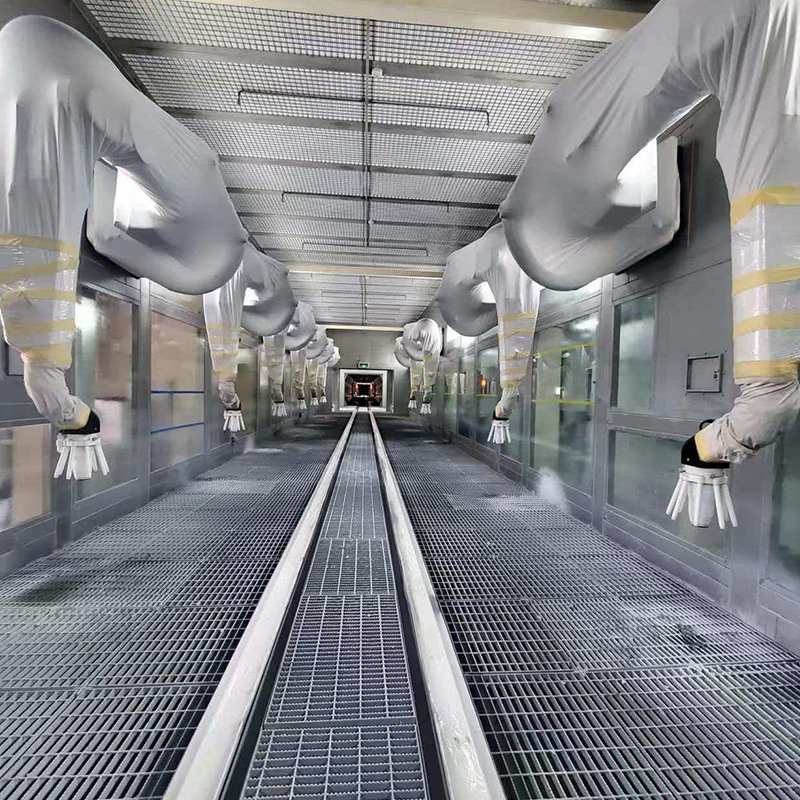
Professional spray coating line specially designed for car wheel manufacturing and refurbishment, applicable to various car wheel types (steel wheel, aluminum alloy wheel, forged wheel, cast wheel, pa...
See Details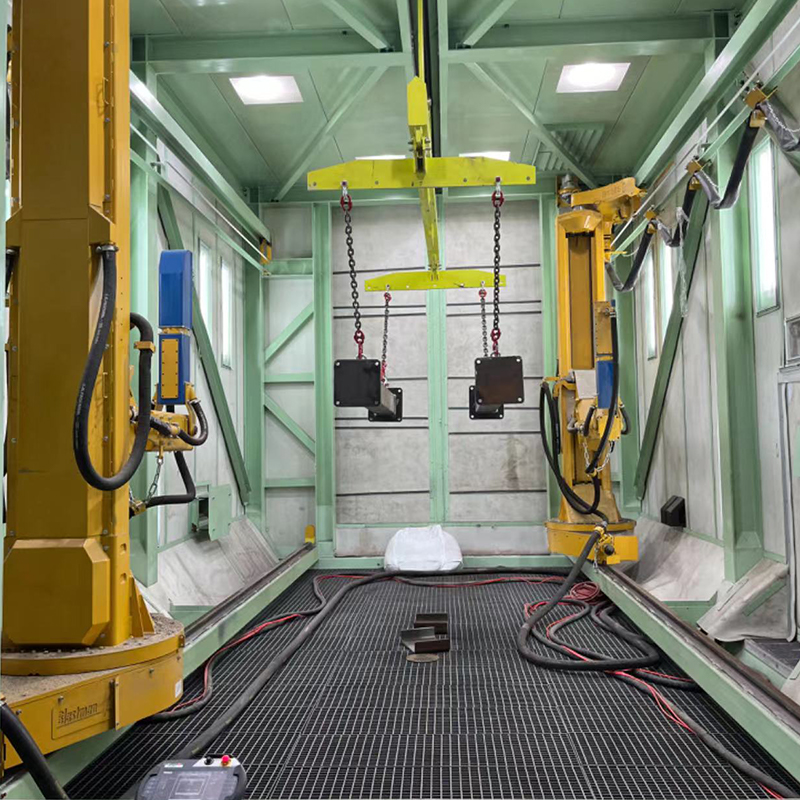
Professional coating line specially designed for large castings and heavy truck parts, applicable to various large castings (engineering castings, mining equipment castings, industrial castings) and h...
See DetailsBuild Your Customized Industrial Coating System
Send us your workpiece information, production capacity, coating process, workshop layout, and environmental requirements. Yueze will help evaluate your project and develop a suitable coating, conveying, drying, and environmental treatment solution.
Main menu
Products
Contact Us
Company Address:
No. 12, Park Avenue, Shanggang Industrial Park, Jianhu, Yancheng City, Jiangsu Province
Message Us Right Now!

Follow us: